Reports
Cybrium generates professional, auditor-ready deliverables from every scan and every adversary campaign. Deliverables are produced asynchronously, stored in the tenant's object store, and shared by download link, secure email, or API.
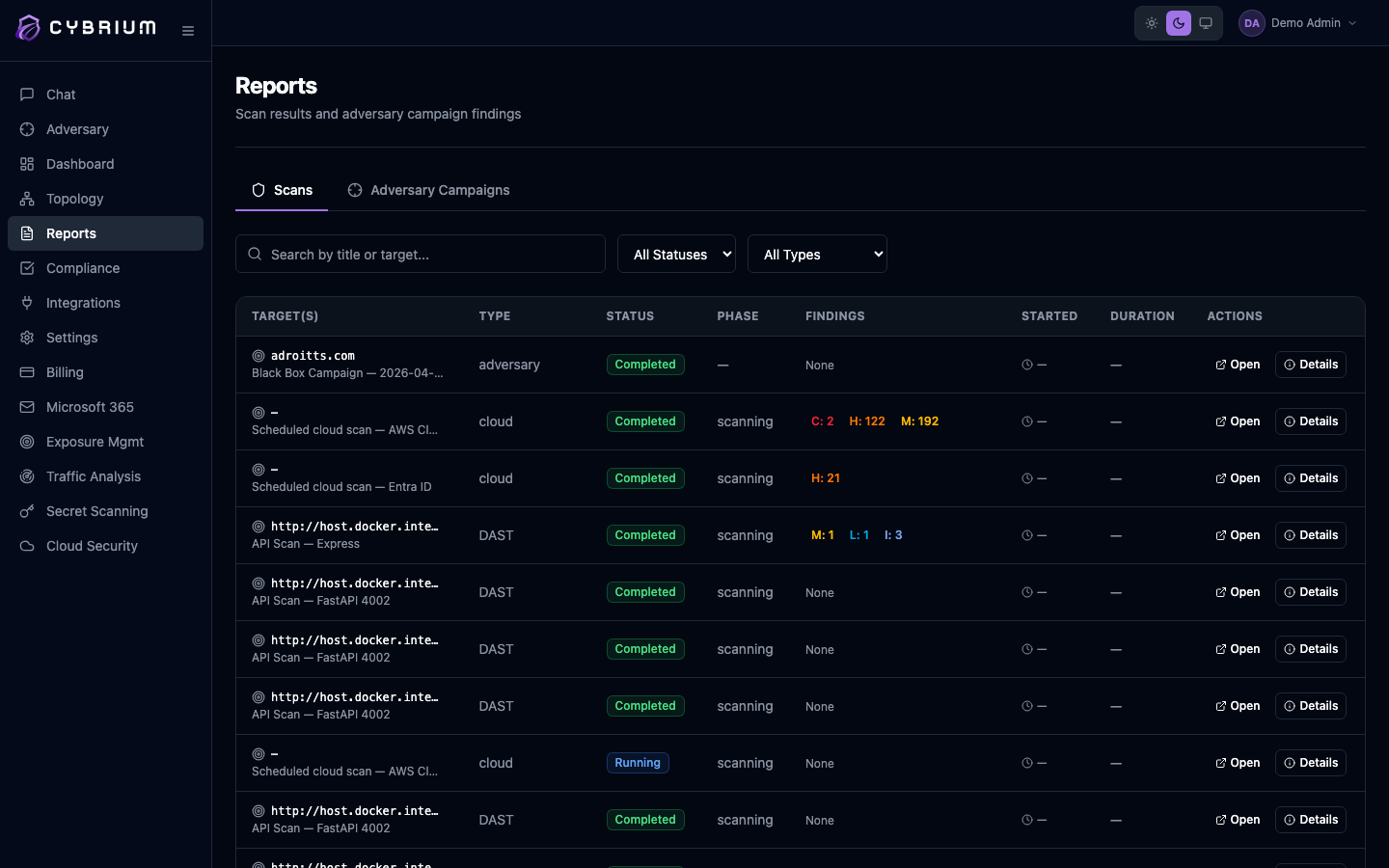
Generation
Click Generate Report on any completed scan, any campaign, any compliance view, or from the Reports page to compose a cross-cutting deliverable. The builder offers a section palette — executive summary, scope, methodology, findings by severity, findings by framework, remediation roadmap, appendix — and you pick which sections to include, which filters to apply, and which brand theme to render with.
White-label branding is available on Enterprise plans. Upload a logo, pick accent colors, and override the cover-page imagery; the resulting PDF looks like your firm's own deliverable.
White-label branding requires Enterprise.
Share via Email
The share dialog sends a deliverable to one or more recipients with a short message. The link is signed, expires after a configurable window (default 7 days), and records every download to the audit log along with the recipient's IP and user agent. Recipients do not need a Cybrium account.
For sensitive content, enable Require Passcode; the dialog generates a one-time code that is sent out-of-band via SMS or voice.
Export Formats
Three formats are generated in a single job and delivered as a bundle:
- PDF — the primary deliverable. Print-perfect, consistent pagination, embedded fonts, clickable table of contents, and hyperlinks from findings to their evidence appendix.
- HTML — a self-contained single-file HTML document, ideal for embedding in internal wikis or customer portals. Uses the same theme as the PDF.
- JSON — the full structured data model: findings, assets, frameworks, mappings, timelines. Use this to feed downstream systems or to drive your own dashboards.
Executive vs. Technical
Two audiences, one dataset. The Executive Summary section opens with a narrative paragraph written by Cybrium's writing model, a risk heatmap, top five exposures, trend versus prior periods, and a recommended next action. Technical Sections follow with per-finding detail — reproduction steps, evidence, affected assets, framework mappings, and proposed remediation — in the format an engineer needs to act on.