Continuous Threat Exposure Management
CTEM is Gartner's five-stage operating model for moving security programs from periodic audits to continuous, evidence-driven exposure reduction. Cybrium implements every stage as a first-class page in the product, with shared data models so findings, assets, and decisions flow between stages without re-keying.
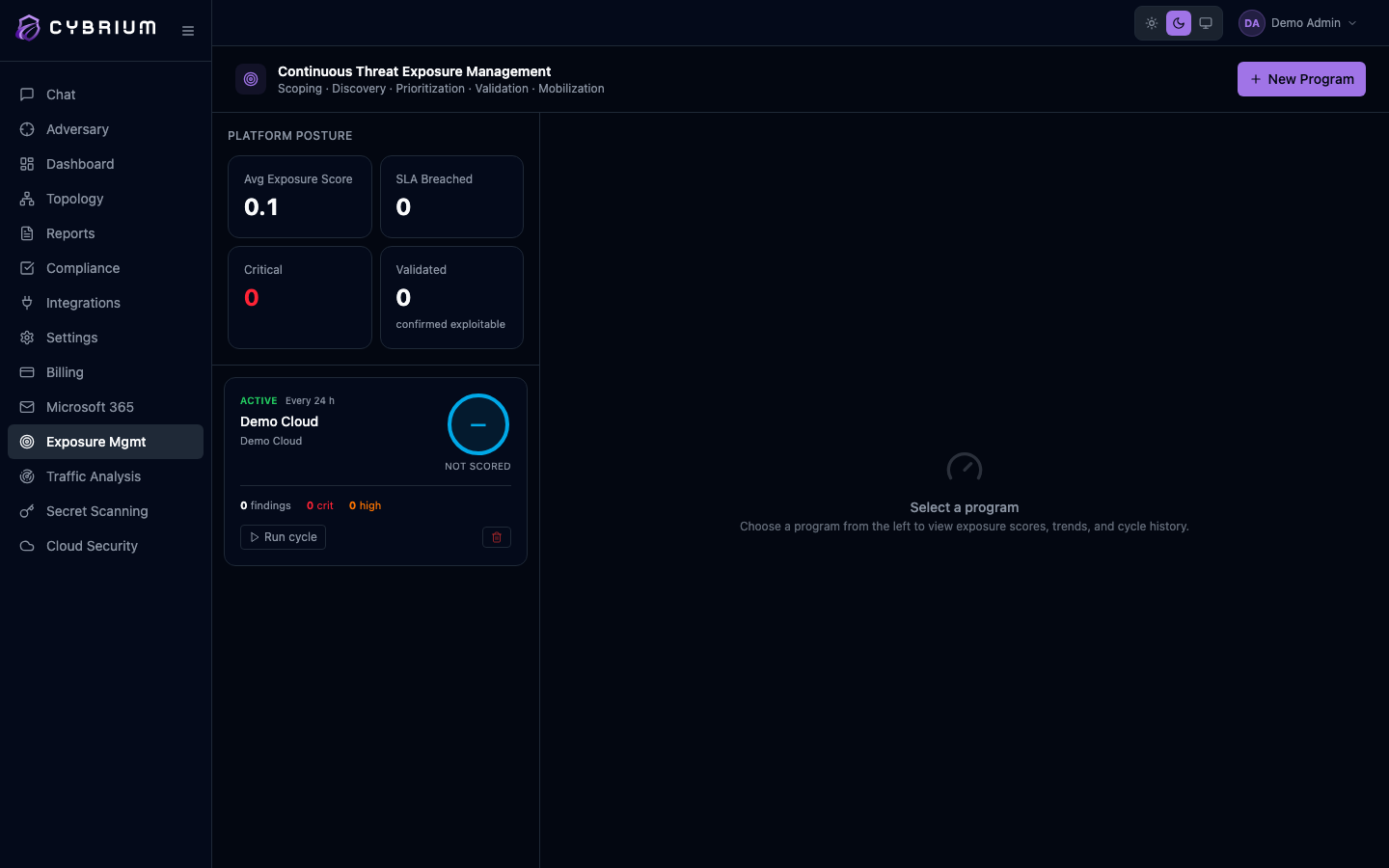
The Five Stages
Scoping. Define what is in play. The scoping page ingests your asset inventory — from cloud connectors, repository imports, domain records, and manual entry — and lets you carve it into business-aligned scopes (by product line, by owner, by compliance boundary). Each scope has its own SLA policy and reporting cadence.
Discovery. Run the capabilities needed to see what is actually out there. Discovery draws on network, web, cloud, identity, code, and SBOM scans, plus adversary campaigns where authorized. Assets and weaknesses land in a unified graph that every later stage reads from.
Prioritization. Rank exposures by real-world risk, not raw severity. Cybrium blends CVSS, EPSS, asset criticality, and exploit availability into an Exposure Score per finding. The score is recomputed nightly as EPSS and threat intel shift.
Validation. Confirm that the exposures the prioritization stage flagged are actually reachable and exploitable. Validation kicks off targeted scans and adversary probes against prioritized findings and updates each finding with one of three verdicts: validated-exploitable, validated-not-exploitable, or inconclusive.
Mobilization. Move validated exposures into remediation. Mobilization fans out tickets to Jira, ServiceNow, or email-to-ticket, applies the scope's SLA policy, and tracks time-to-remediate against it. Breach-of-SLA triggers notifications to owners and, optionally, to leadership dashboards.
Exposure Score
The Exposure Score is a 0–100 composite. Its inputs are CVSS base, environmental context (internet-facing, authenticated, data sensitivity), EPSS probability-of-exploitation, and presence in public exploit catalogues. Scores above 80 surface to the executive dashboard automatically.
SLA Policy
Each scope declares a target time-to-remediate per severity tier. SLA clocks start the moment a finding is validated-exploitable and pause only when the ticket status enters a resolved state.
